
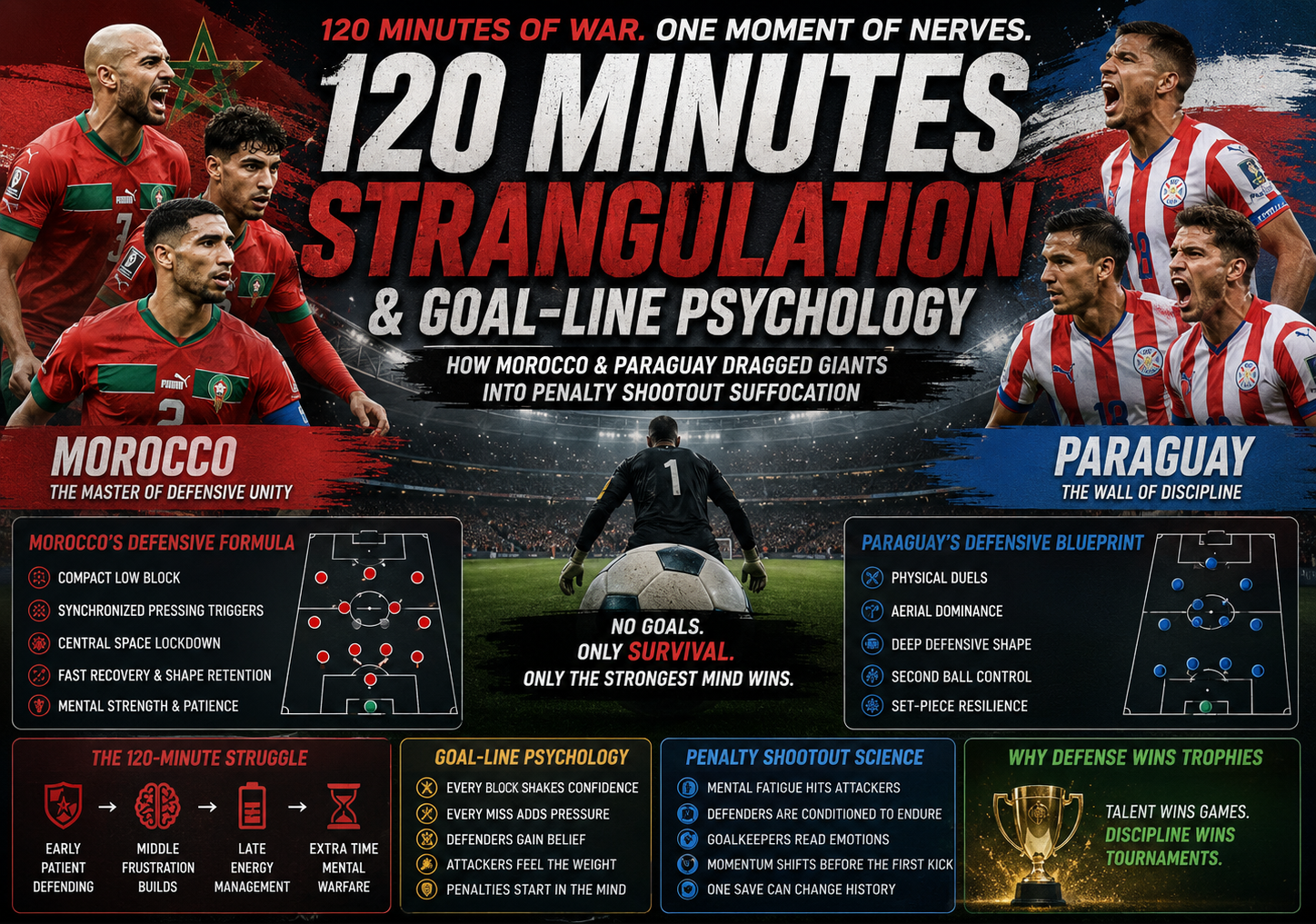
120 Minutes Of Defensive Perfection
How Morocco and Paraguay forced football giants into penalty shootout survival.
When Defending Becomes An Offensive Weapon
Modern World Cup knockout football is no longer won exclusively through attacking brilliance. Morocco and Paraguay demonstrated another path toward survival: compressing space, controlling rhythm, and extending matches until every psychological advantage shifted toward the defensive side.
Instead of chasing possession statistics, both teams focused on minimizing danger inside central areas while inviting opponents into increasingly uncomfortable attacking situations. As minutes accumulated, the pressure gradually transferred from the defenders to the favorites expected to score.
This tactical philosophy transformed the entire knockout battle into a contest of patience, concentration, and emotional endurance.
Why 120 Minutes Changed Everything
Every additional minute increased physical fatigue, reduced attacking precision, and amplified psychological pressure. Morocco and Paraguay intentionally slowed the rhythm whenever possible, turning each stoppage into valuable recovery time while frustrating technically gifted opponents.
- Compact defensive spacing prevented central penetration.
- Wide defensive shifts forced low-percentage crosses.
- Minimal pressing conserved physical energy.
- Clear communication maintained defensive synchronization.
- Emotional discipline prevented unnecessary fouls.
Goal-Line Psychology: The Hidden Battle Nobody Sees
Penalty shootouts begin long before the referee points to the spot. Throughout 120 minutes, defenders continuously influence attackers' confidence by blocking shots, winning aerial duels, and surviving dangerous moments.
Every clearance reinforces belief inside the defending team while simultaneously increasing doubt among attacking players. This invisible momentum gradually shifts emotional control toward the underdog.
Psychological Chain Reaction
- Blocked shots increase attacking frustration.
- Repeated clearances strengthen collective confidence.
- Missed opportunities accelerate emotional pressure.
- Crowd tension becomes an additional defensive ally.
- Penalty kicks begin with unequal mental states.
Morocco's Defensive Intelligence
Morocco once again demonstrated why they remain one of international football's most organized defensive teams. Their compact shape rarely exceeded twenty-five meters from midfield to defensive line, eliminating passing lanes between the lines.
Instead of aggressively chasing the ball, Morocco patiently waited for predictable passes before launching coordinated pressing triggers. This selective pressure conserved energy while maintaining tactical stability throughout two exhausting hours.
Morocco's Defensive Principles
- Compact low defensive block.
- Excellent defensive spacing.
- Controlled pressing triggers.
- Fast transition recovery.
- Strong aerial dominance.
- Disciplined tactical fouls only when necessary.
Rather than attempting spectacular individual defending, Morocco relied upon synchronized movement, making every player responsible for protecting collective space rather than individual opponents.
Paraguay's Relentless Defensive Structure
Unlike Morocco's compact positional discipline, Paraguay relied on physical duels, relentless work rate, and exceptional aerial defending. Their defensive philosophy focused on winning every first contact before immediately recovering second balls.
Every defender remained connected through constant communication, preventing attackers from exploiting gaps inside the penalty area. Rather than chasing possession, Paraguay concentrated on controlling danger zones and limiting clear shooting opportunities.
Paraguay Tactical Identity
- Strong aerial superiority inside both penalty areas.
- Physical one-versus-one defending.
- Aggressive second-ball recovery.
- Compact midfield screening.
- Quick defensive reshaping after transitions.
- Excellent concentration during set pieces.
This disciplined approach frustrated technically superior opponents by forcing them into repeated low-percentage attacks while continuously draining their confidence.
120-Minute Defensive Timeline
The match developed into four distinct tactical phases, each requiring different defensive priorities and psychological adjustments.
By maintaining tactical discipline across every phase, both Morocco and Paraguay gradually transformed defensive survival into strategic advantage.
Why Elite Defensive Teams Often Excel In Penalty Shootouts
Penalty shootouts are rarely decided by technical ability alone. Teams that successfully defend for 120 minutes usually enter the shootout with stronger collective belief, greater emotional stability, and clearer tactical routines.
- Goalkeepers remain mentally engaged throughout the match.
- Defenders gain confidence from repeated successful interventions.
- Opponents carry the emotional burden of missed chances.
- Physical rhythm favors disciplined teams.
- Momentum often shifts toward the underdog before penalties begin.
Key Players Behind The Defensive Masterclass
- Achraf Hakimi — Leadership, recovery speed and defensive transitions.
- Nayef Aguerd — Dominant aerial presence and positional intelligence.
- Romain Saïss — Defensive organization and communication.
- Sofyan Amrabat — Midfield protection and ball recovery.
- Gustavo Gómez — Paraguay's defensive leader and aerial specialist.
- Omar Alderete — Physical defending and penalty-area control.
- Andrés Cubas — Midfield screening and defensive balance.
- Carlos Coronel — Goalkeeping composure under immense pressure.
Frequently Asked Questions
Why were Morocco and Paraguay able to survive 120 minutes?
Their compact defensive organization, disciplined positioning, and excellent physical conditioning minimized dangerous chances throughout the match.
What is Goal-Line Psychology?
Goal-Line Psychology describes the gradual mental pressure attackers experience after repeated missed opportunities and successful defensive actions.
Why do low-block systems remain effective?
Compact defensive structures reduce high-quality shooting opportunities while forcing opponents into predictable attacking patterns.
Can this tactical approach succeed against elite teams?
Yes. Modern knockout football repeatedly demonstrates that disciplined defensive systems can neutralize technically stronger opponents over long matches.
Explore More National Team Collections
Final Verdict
Morocco and Paraguay proved that elite tournament defending extends far beyond simply protecting the penalty area. Their performances showcased tactical discipline, emotional resilience, intelligent space management, and exceptional defensive communication across 120 exhausting minutes.
Rather than allowing technically gifted opponents to dictate every phase, both teams gradually shifted psychological pressure onto the attacking side. Every interception, clearance, and blocked shot strengthened collective belief while increasing frustration among the favorites.
This tactical blueprint illustrates an increasingly important trend in modern World Cup football: structured defending, intelligent game management, and mental endurance can be just as decisive as attacking brilliance. When knockout football reaches extra time, organization often becomes the greatest weapon of all.