
Messi Makes History As World Cup Race Intensifies
Argentina, France, Norway and Algeria shape a dramatic matchday.
A Matchday Defined By Milestones And Tactical Masterclasses
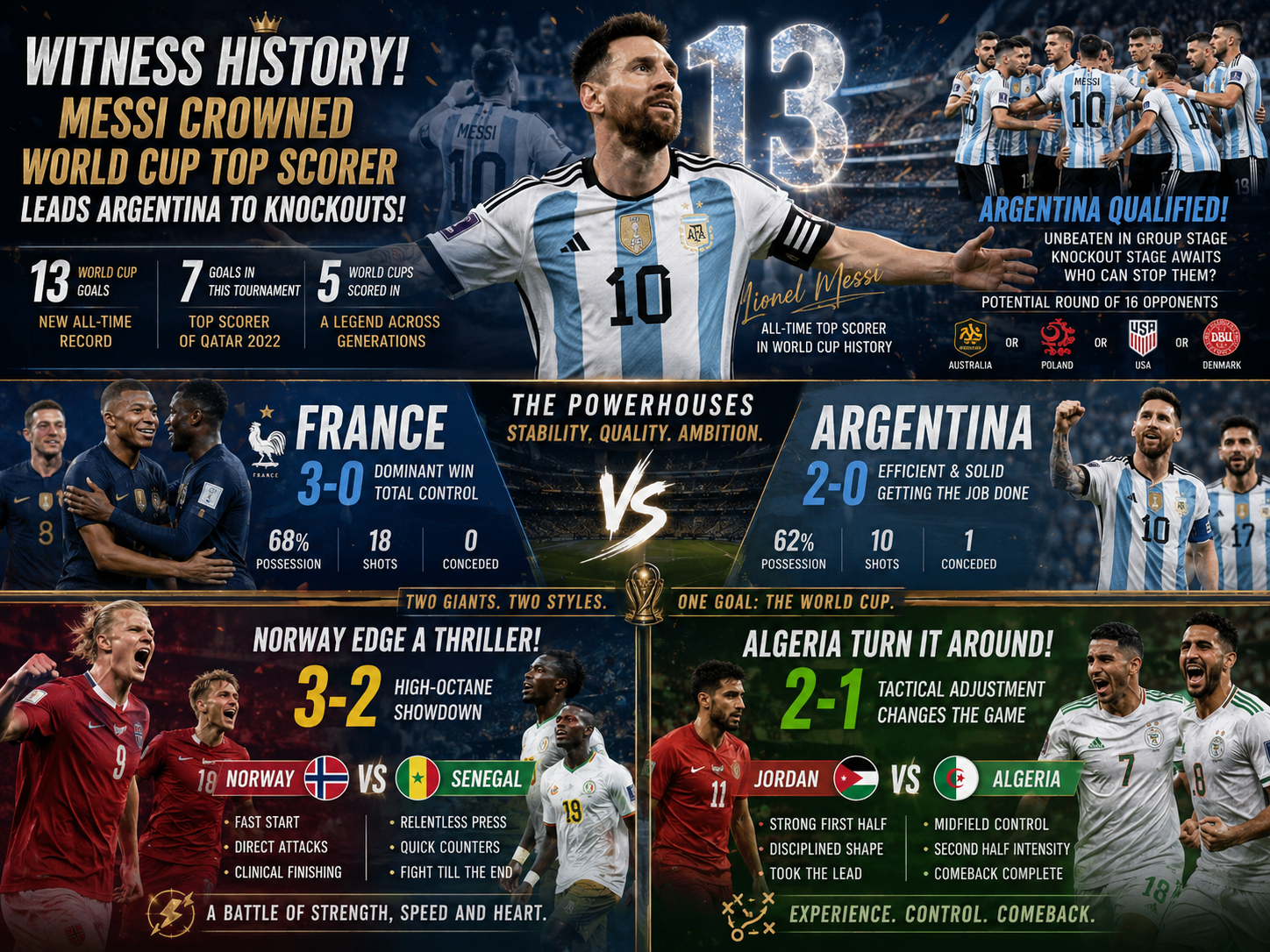
The second round of the World Cup delivered one of the most significant days of the tournament so far. Lionel Messi reached another historic milestone, Argentina secured qualification for the knockout stage, France continued to demonstrate championship-level consistency, Norway survived a thrilling attacking battle against Senegal, and Algeria showcased tactical flexibility in a comeback victory over Jordan.
For teams chasing knockout qualification, every tactical adjustment now carries enormous significance. The margin between progression and elimination is becoming increasingly narrow as the competition enters its decisive phase.
Messi Becomes The New World Cup Scoring King
Lionel Messi once again reinforced his status among football's greatest players by reaching another remarkable World Cup scoring milestone. Beyond the individual achievement, Argentina's victory secured early qualification and allowed the coaching staff to begin evaluating potential knockout-stage pathways.
Argentina's tactical evolution throughout the tournament has been driven by midfield control, positional rotations, and intelligent occupation of half-spaces. Rather than relying solely on moments of brilliance, the team now functions as a highly synchronized collective unit.
Potential knockout opponents will face a team capable of dominating possession while also exploiting transition opportunities with devastating efficiency.
France Continues To Display Championship Credentials
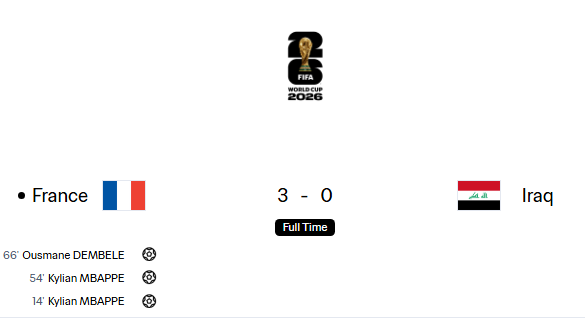
France's 3-0 victory was less about the scoreline and more about complete tactical control. Their ability to compress space, recover possession quickly, and transition into attack remains among the strongest in the tournament.
The balance between defensive structure and attacking freedom continues to separate France from many competitors. Every line of the team appears connected, minimizing vulnerabilities while maximizing attacking efficiency.
When comparing France and Argentina, both nations currently appear among the most stable contenders for a deep tournament run. Their ability to control matches through different tactical approaches highlights their championship potential.
Norway And Senegal Deliver A Tactical Shootout
Norway's dramatic 3-2 victory over Senegal showcased two teams with vastly different strengths. Norway relied on aerial dominance, physical presence, and direct attacking patterns, while Senegal used pace, mobility, and aggressive transitional attacks.
The match evolved into an end-to-end contest where neither side was willing to sacrifice attacking ambition. Norway ultimately prevailed through superior efficiency inside both penalty areas.
This victory strengthens Norway's position as one of the tournament's most dangerous direct-attacking teams.
How Algeria Reversed The Match Against Jordan
Algeria's comeback victory was built upon intelligent midfield adjustments after halftime. During the opening period, Jordan successfully disrupted central progression lanes and limited Algeria's ability to control possession.
The coaching staff responded by increasing midfield mobility, creating overloads in advanced areas and generating better connections between the defensive and attacking units.
Once Algeria established numerical superiority in midfield zones, Jordan struggled to maintain defensive compactness. The match gradually shifted in Algeria's favor and culminated in a deserved comeback victory.
Players Who Defined The Matchday
Lionel Messi
Historic scoring milestone and leadership in qualification.
Julián Álvarez
Movement and pressing continue to complement Argentina's attack.
Kylian Mbappé
France's primary transition weapon and constant attacking threat.
Aurélien Tchouaméni
Controlled midfield tempo and defensive balance.
Erling Haaland
Physical dominance and finishing quality drove Norway forward.
Martin Ødegaard
Created structure and creativity between the lines.
Riyad Mahrez
Provided attacking quality during Algeria's comeback.
Ismaël Bennacer
Key architect of Algeria's midfield transformation.
Tactical Themes Of The Day
- Elite midfield control continues to define successful teams.
- France and Argentina demonstrate exceptional structural balance.
- Norway's direct attacking model remains highly effective.
- Midfield adaptability transformed Algeria's performance.
- Possession without penetration remains a challenge for several nations.
- Knockout-stage qualification increasingly rewards tactical flexibility.
Explore More National Team Collections
FAQ
It moved him to the top of the World Cup scoring rankings and further strengthened his legendary tournament legacy.
Their balance between defensive organization and attacking efficiency remains among the best in the competition.
Norway combined physical dominance, aerial superiority, and efficient finishing to edge a highly competitive match.
Midfield adjustments improved ball progression and created numerical advantages that eventually broke Jordan's structure.
Final Verdict
This World Cup matchday combined historic milestones, elite tactical execution, and dramatic momentum shifts. Messi's record-breaking achievement headlines the story, but France's consistency, Norway's resilience, and Algeria's adaptability may prove equally important as the tournament moves toward the knockout rounds.
The strongest teams are no longer defined solely by talent. Tactical flexibility, structural balance, and the ability to adjust under pressure are becoming the true markers of championship potential.